Over the past couple of years I have been co-facilitating a book club for the Maryland Association of Environmental and Outdoor Education (MAEOE), and this spring, our book was aptly chosen – Silent Spring by Rachel Carson, a marine biologist and conservationist whose work was well ahead of her time. This book was published in 1962 and eventually led her to become known as the mother of the modern environmental movement.
Through this book study, I learned so much, not only about her research and the history of the environmental movement, but about the amazingly devoted person that Rachel Carson was to those whom she deeply loved – her family. Her lyrical writing, and her wonder about the natural world was earnest, transformative, and life affirming. The Silent Spring book club led me to not only meet the lovely Rebecca Henson, founder of the Springsong Museum, a community museum inspired by Rachel Carson, but to also discover Rachel Carson’s Wonder-Filled World, a nonfiction picture book by the joy-filled children’s author Kate Hannigan. Kate was an enthusiastic guest during our final book club meeting, and I am thrilled to spotlight her on my blog.
Rachel Carson’s Wonder-Filled World: How the Scientist, Writer, and Nature Lover Changed the Environmental Movement written by Kate Hannigan and illustrated by Katie Hickey. Published by Calkins Creek, An imprint of Astra Books for Young Readers, ©2025
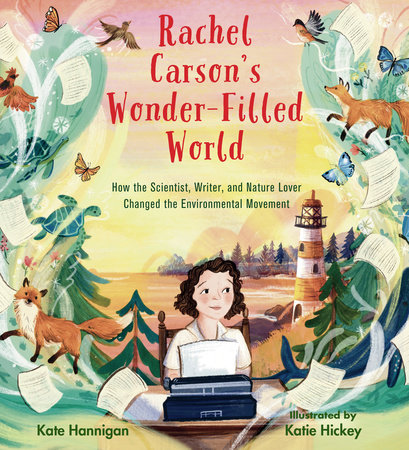
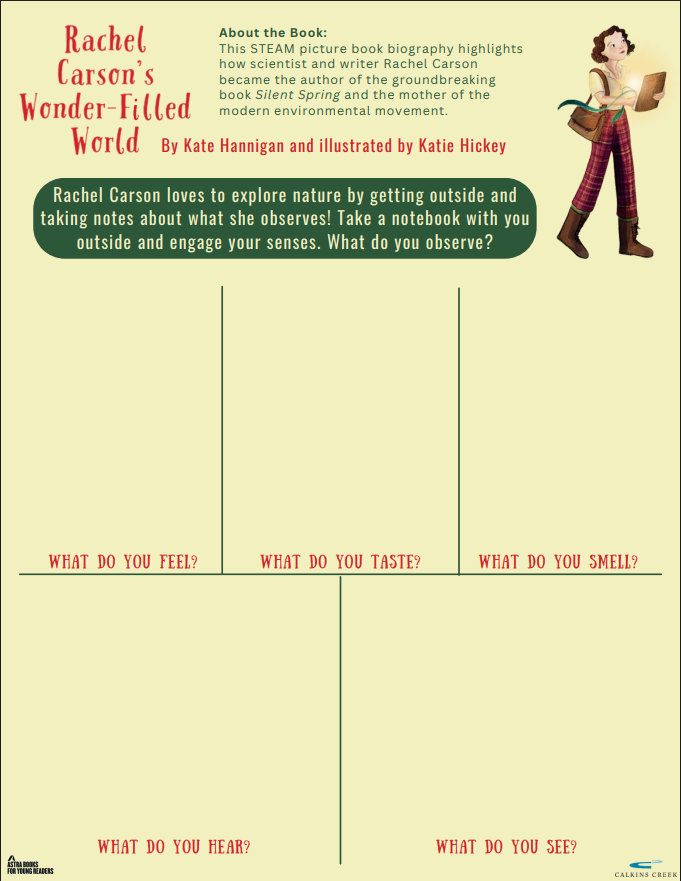
In Rachel Carson’s Wonder-Filled World, you pivot from the heavy scientific warnings of Silent Spring to focus on Rachel’s “sense of wonder” and the five senses. How do you feel this approach helps young readers connect more deeply with scientific figures compared to a standard chronological biography?
I always try to start a project thinking about the young reader’s experience. I want my stories to be accessible, so I go at them with that top of mind. With Rachel Carson’s story, I decided to look at her sense of wonder with the world and how she loved nature because she was immersed in it from an early age. DDT is an enormous thing to explain! So I knew I was not going to approach her story from the angle of pesticide overuse. But every child can understand that we use our senses to take in the world. That became my starting point: what our eyes see, our ears hear, our noses smell, our fingers touch, our tongues taste. Even kids who don’t spend a lot of time in nature understand the feeling of the wind on our face or listening to birdsong. That’s accessible.
Rachel Carson was both a scientist and a writer—a duality you share as an author who meticulously researches history. What was the most surprising “gem” you found during your research for this book that highlighted Rachel’s poetic side?
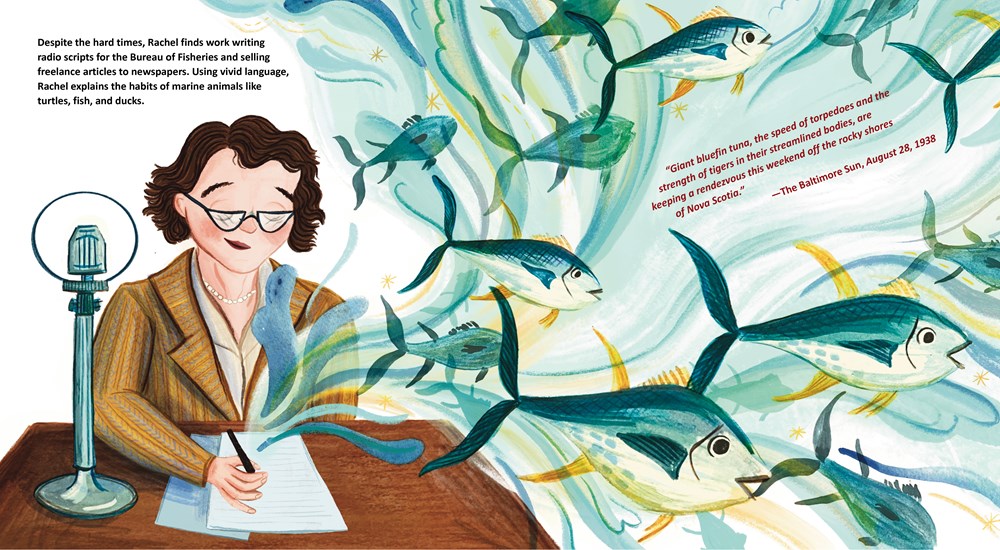
“Giant bluefin tuna, the speed of torpedoes and the strength of tigers . . .” I knew Rachel Caron could write, but when I read her work even before Silent Spring, I was bowled over by the rich language. She was simply describing fish! But her word choice and imagery were gorgeous. I hadn’t expected that. ” . . . shining green and silver caravans wound in and out, swerving, diverging, and merging again, or at a sudden fright darting away like a shower of silver meteors.”
Holy cow, this was poetry. From a marine biologist no less!
Kate, I’m looking forward to sharing your book with my elementary school’s Green Teams – specifically for this reason! I want my young environmentalists to know you can be both a scientist and a creative at the same time! Thank you, also, for creating the wonder-filled classroom guide, which is available on the Calkins Creek Astra Books for Young Readers website here. MAK
There’s lots of research out there about the importance of getting out in nature for both our mental and physical health, and children having a nature deficit. As a regular visitor to schools and libraries, what role do you think “nature-focused” biographies play in modern school libraries, especially for children who are increasingly spending more time in front of screens?
I think these types of books get kids thinking. And curiosity is a great motivator. They might see a butterfly in a picture book and that sparks an interest. Or maybe a beautiful fish. Maybe they read about endangered birds or see an illustration of birds, then they start looking up at the sky and noticing flocks flying in a V formation overhead for the first time. Or maybe they’re going camping on the weekend and a nature book helps them prepare for this new adventure. Or perhaps it gets them asking their parents to take them on a camping trip or a hike into the woods. I like to think of these books as catalysts that can lead to engagement with the outdoors. Because we can’t protect what we don’t know. And if kids grow up without knowing nature and our outdoor spaces, they won’t be able to protect it.
Kate, this is the one of the many reasons that I have been working on my environmental educator certificate – so that I can better guide my students as we explore nature, experience nature, and love nature. The more my students learn to love nature, the more they will find their place in the natural world, and their reason to save it. MAK
“I like to think of these [nature-based] books as catalysts that can lead to engagement with the outdoors. Because we can’t protect what we don’t know. And if kids grow up without knowing nature and our outdoor spaces, they won’t be able to protect it.“
-Kate Hannigan
The illustrations in this book by Katie Hickey beautifully capture the transition from Rachel’s childhood on a farm to her work as a marine biologist. When writing a picture book biography, how much of the “visual storytelling” do you envision while writing? Did you share a lot of illustration notes, or none at all ? Since authors and illustrators don’t usually meet, did Katie’s illustrations bring to life what you had envisioned? When you first saw her illustrations, and now have had time to study them, what do you love the most about them?
Katie did an amazing job with this book! I love her use of color. The vibrant illustrations on every page are irresistible! Illustrating a writer at work has the potential to be static, but Katie makes the pages so dynamic and exciting. I’m grateful that we were paired up for this project. There’s always some back and forth about historical accuracy and the “vision” for a book’s overall look. But for the most part, the illustrator should be left alone to do what she does best, as the author is left alone to do her thing. There’s a mutual respect for each other’s art, while at the same time a desire to get all the details right and produce the best book possible.
Many librarians manage their own blogs or other writing projects (including me). Given your experience writing about “Hidden Heroes” and historic figures, what is your top tip for finding those untold stories that are just waiting to be turned into a narrative?
Read. Listen. Poke around and be nosy. I stumble on stories everywhere. One of my favorite writing projects was about Kate Warne, the first lady detective in the U.S. She was a Pinkerton detective who helped save the life of Abraham Lincoln, but she wasn’t even a footnote in history. I stumbled onto a paragraph about her while researching an entirely different story. I was so fascinated by what I read, I began to dig a little deeper, and I ultimately abandoned the original project to write Kate Warne’s story. It’s a middle-grade novel called The Detective’s Assistant, where a fictional 10-year-old takes us through the adventures with Kate Warne, Lincoln, and Pinkerton himself. It was a joy to research and write, and it drew the interest of multiple movie producers!
Kate, you have written many wonderful fiction, historical fiction, and nonfiction books, many focused on females. Thank you for sharing their stories and empowering your young readers! MAK
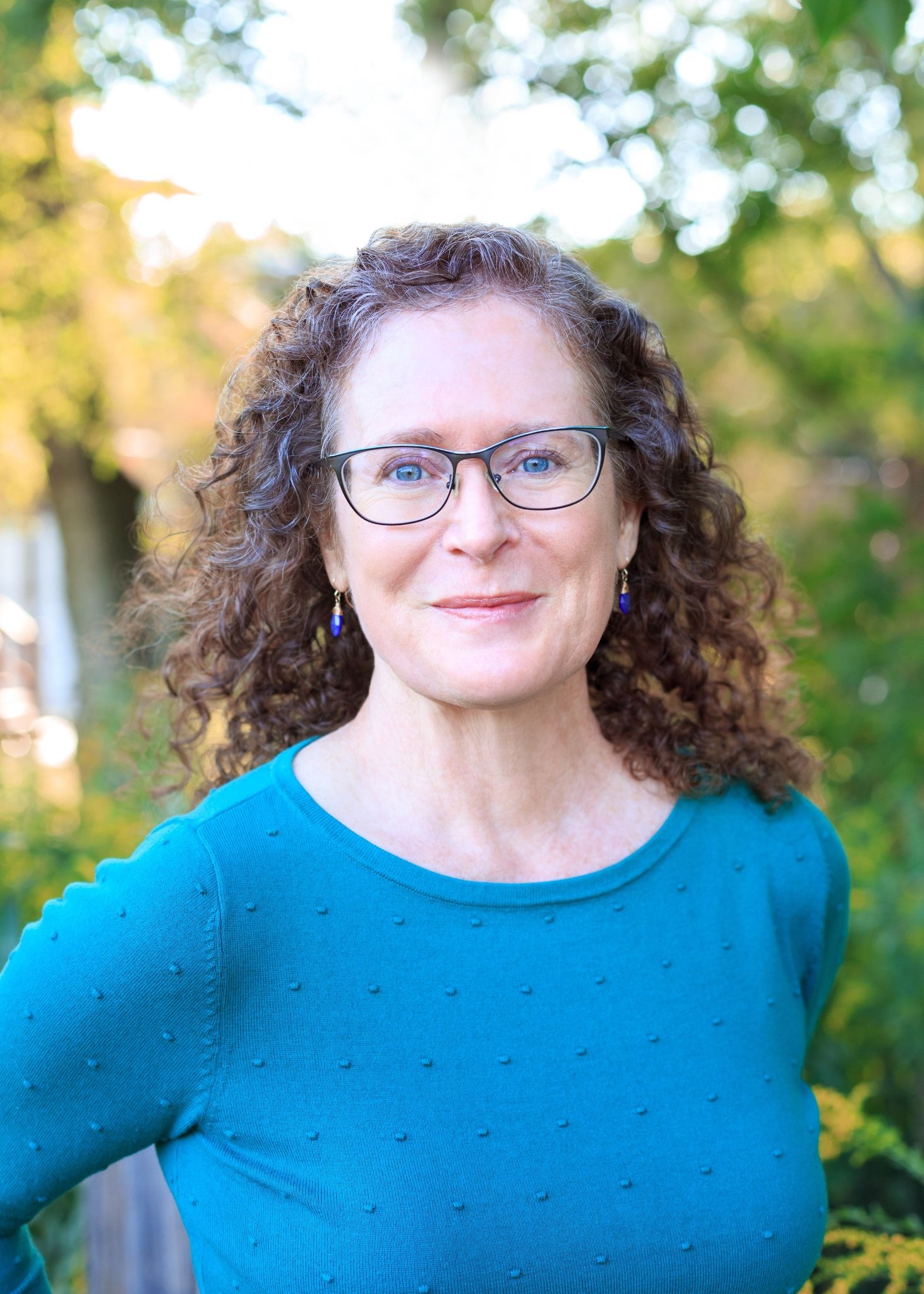
To learn more about Kate Hannigan and her books, please visit her website https://www.katehannigan.com/
To learn more about Rachel Carson and her body of work, please visit the following resources:
- Rachel Carson | American Experience | PBS
- Rachel Carson: A Resource Guide (Library of Congress)
- Silent Spring MAEOE Book Club Slides
- Springsong Museum
- The Life and Legacy of Rachel Carson
Books by Rachel Carson:
- The Sense of Wonder by Rachel Carson, 1965 & 1998
- Text copyright, 1956
- Introduction copyright, 1998 by Linda Lear
- Photographs copyright, 1998 by Nick Kelsh
- The Edge of the Sea by Rachel Carson, 1955
- The Sea Around Us by Rachel Carson, 1952
- Under the Sea-Wind by Rachel Carson, 1941
 The Creative Librarian