John Schu: Connector of books, readers, empathy, understanding, and joy!

The first thing you notice about John Schu is his smile and the joy that emanates from him. Ask him about what he’s reading, and that smile will widen and he’ll tell you all about it, including how good it smells. In 2011 he was named a Library Journal Mover and Shaker for “his dynamic interactions with students and his passionate adoption of new technologies as a means of connecting authors, illustrators, books, and readers.” He has never stopped being a Mover and Shaker in children’s literature – just follow him on social media and you will see him spotlighting all of the authors and illustrators of the books he reads. He is the children’s librarian for Bookelicious, a part-time lecturer at Rutgers University, and shares his love of reading with countless librarians, educators, and students around the world.   

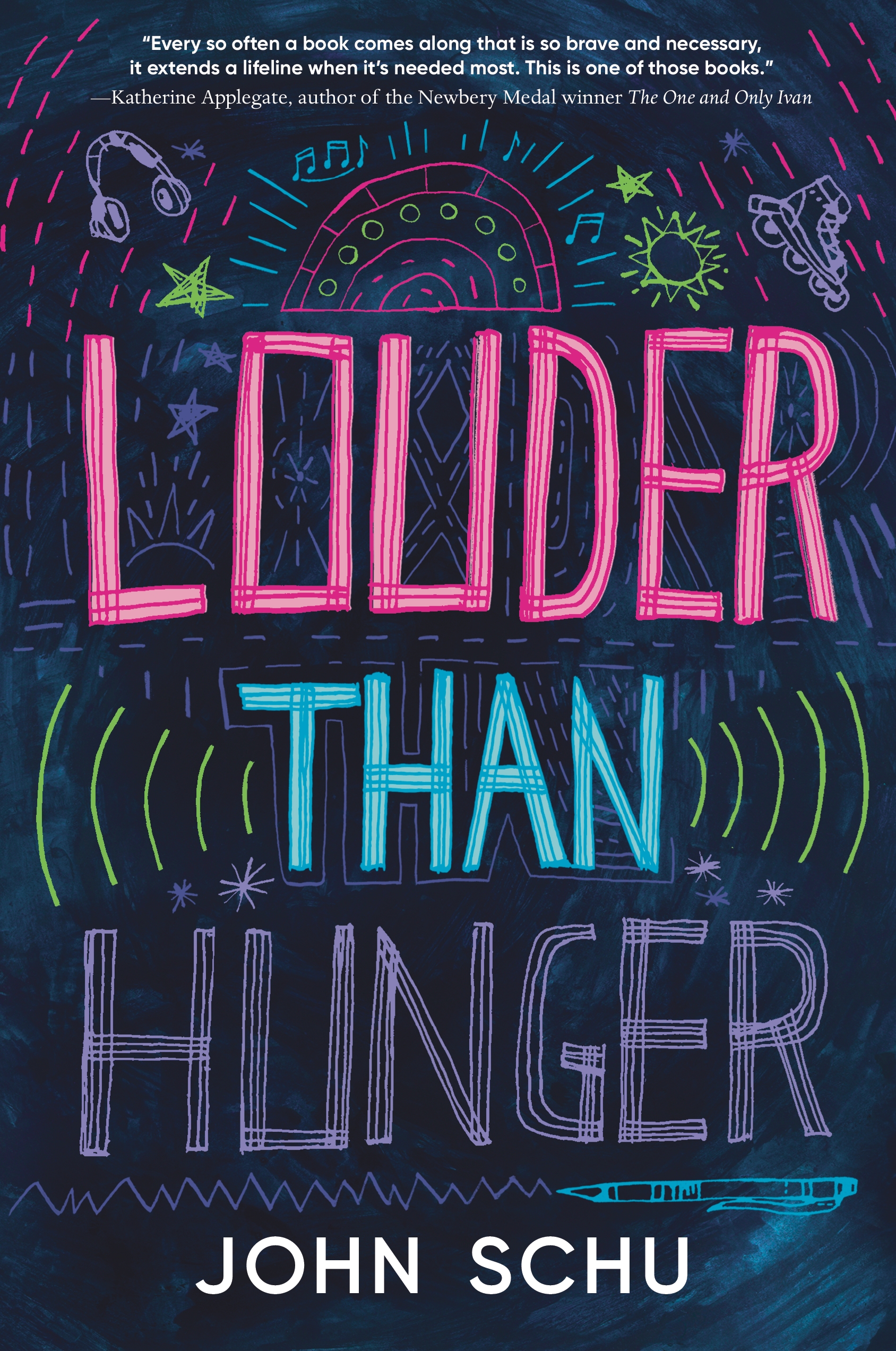
I am thrilled that John Schu will be bringing his important book, Louder Than Hunger, to the 15th Annual  Gaithersburg Book Festival on May 18th at Gaithersburg’s Bohrer Park.  John will be presenting along with Nicole Melleby (Winnie Nash is Not Your Sunshine) in the Nash Young Adult Pavillion beginning at 10:15 am.

John, I met you several years ago, when you were the Ambassador of School Libraries for Scholastic Book Fairs and I enjoyed seeing your genuine book joy then, and how you continue to share joy to this day.  When did you develop your love of, and for, books?

John Schu: Thank you! I always love celebrating stories and books! 

In Louder Than Hunger, Jake thinks about his favorite books a lot. 

This is a passage from pages 173-174. 

Grandma bought me 

Goofy’s Big Race

from the grocery store

when I was six or seven. 

She used a coupon. 

Slow and steady,

steady and slow,

that’s the way to go.

I asked her to read it aloud

over

and

over

and 

over 

again.

Until I memorized it. 

Slow and steady,

steady and slow,

that’s the way to go.

Until it crawled inside my heart

and rested there. 

_________________

Goofy’s Big Race hooked me on reading. It’s tattooed on my heart. 

Louder Than Hunger has had many wonderful, truly outstanding, reviews.  Which has been the most important or meaningful to you?

John Schu: I’m so, so, so grateful for all the outstanding words of praise. 

The most meaningful praise has come in the form of letters from middle schoolers and high schoolers. 

They are sharing their hearts with me. 

They tell me about their favorite parts of the book. 


When they cried. 

How they have struggled with a negative voice in their heads. 

How they better understand what it might feel like to have an eating disorder. 

How they’ve developed more compassion by spending time with Jake. 

You have been very open with your struggles with an eating disorder, and that Louder Than Hunger is a memoir in many ways.  How are you doing today?

John Schu: In Louder Than Hunger, Counselor Ruth says to Jake,

Therapy is a chance to talk with someone about the things that are important to you in an effort to make your life easier, better, and more fun.

I’m living a life that is easier, better, and more fun! 

In your NPR interview you mentioned that the Voice went from having a capital “V’ to a lowercase “v”.  Does the voice ever disappear completely in both Jake’s life, and yours?

John Schu: Thank you for listening to my interview with Scott Simon. It was such an honor to chat with him.

Sometimes I struggle with a lowercase v. Thanks to therapy and strategies that I incorporate into my daily life, I talk back to the voice and figure out why it is talking to me. 

The interactions between Jake and his grandmother were some of my favorites.  Thank you for spotlighting the special bond between grandparents and grandchildren.  What do you think your Grandmother would say to you, had she been alive to read your book and see its widespread acceptance and acclaim?

John Schu: Oh my goodness! This question makes me weepy! 

I think she would say . . . 

You are healthy.

You are loved.

You are strong.

You are determined. 

You are fulfilling your dreams…

(Note: The You are . . . structure will make more sense after you read Louder Than Hunger.) 

Last year, Jarrett Lerner’s novel in verse, prose, and illustration about body dysmorphia, A Work in Progress*, published in 2023 and has had similar success to Louder Than Hunger … why do you think that both books have been embraced so completely? 

John Schu: In the short time Louder Than Hunger has been out in the world, I’ve received MANY email messages from family members of males who are struggling with anorexia and bulimia. I think both books are being embraced by readers of all ages because many people are ready to have these important conversations about disordered eating and mental health.

*(Jarrett was a featured author at the 2023 Gaithersburg Book Festival, where I moderated a panel discussion with two other middle grade authors.  I also interviewed him for my blog  Thankfully, We’re All Works In Progress)

Who is your cover illustrator, and what are your thoughts about the cover art?  Does it express what you hoped it would?

John Schu: I’m SOOOOOO grateful for Grady McFerrin, the cover illustrator, and Maria T. Middleton, the cover designer. The cover—the entire package—expresses everything I hoped for and more! The cover pops on a shelf! It makes me smile! 

Lastly, what message do you have for the readers of your books, specifically Louder Than Hunger, but also your picture books, This is a School and This is a Story?

John Schu: The words connect and connection are always on my heart and mind when I write. 

I hope my books help readers make connections. 

I hope they help build empathy and understanding in readers of all ages.

I hope they help facilitate necessary conversations about schools and libraries and poetry and mental health.

I hope my books inspire readers to write their own stories. 

Thank you, John, for taking time to answer these questions for me!  I look forward to meeting you in May at the Gaithersburg Book Festival, where I will be introducing you and Nicole Melleby.

John Schu: Thank you so much! See you in Gaithersburg! 
An Elementary School Librarian’s Book Selection Process

This is the third blog post in a series about library book selection in Maryland (originally published on the Maryland Association of School Librarians blog on December 27, 2023).

In earlier posts you read about processes for evaluating and selecting books from high school librarian Brittany Tignor, and former middle school librarian Dr. Jennifer Sturge, who is now a school library coordinator in her county school system.  While each of our Maryland school systems has a slightly different book evaluation and selection process, our ultimate goal is the same: to curate a library collection of quality books that encourage our students to read. 

This post will be about an elementary school librarian’s process for selecting books for her school library collection. My name is Melissa King, and I am an elementary school librarian in Montgomery County Public Schools.  In our school system of 211 schools (and counting!) we have a well-honed process for reviewing and selecting books for our diverse school communities and school libraries. Every school library media specialist in MCPS is part of the evaluation and selection process.

It is extremely important for me to include books that reflect my students and also shed light on different perspectives.  Ohio State University professor, Dr. Rudine Sims Bishop, in her article, “Windows, and Sliding Glass Doors”, stated, “Books are sometimes windows, offering views of worlds that may be real or imagined, familiar or strange. These windows are also sliding glass doors, and readers have only to walk through in imagination to become part of whatever world has been created or recreated by the author. When lighting conditions are just right, however, a window can also be a mirror.” 

This means that I want to have books in my library that students can see themselves in, books that they can learn about people different from them, and also have books where they can immerse themselves into the story. It means that I make thoughtful consideration of books that I include in my library collection.

There’s many steps that go into developing a library collection. Just as Jen mentioned in her blog post, I also believe it is both an art and a science. One way that I identify books that I would like to add to my school library collection is by following fellow school librarians, as well as authors and illustrators on social media. I use social media as a professional learning network, and read about newly published titles online.  Additional ways in which to learn about new book titles is to read professional review publications such as Kirkus Reviews, School Library Journal, Booklist Online, and Publishers Weekly. I utilize TeachingBooks, a helpful online resource that my county school system purchases. Follett Destiny, our online library catalog system, provides a variety of book and library resources, including Titlewave professionally curated content, and TitleWise collection analysis.  Lastly, I seek, and receive, book recommendations from my colleagues and requests from students, who are ready to share their thoughts about topics and favorite authors.

For a book to be added to an MCPS school library collection, it goes through a formal evaluation and selection process. MCPS Regulation IIB-RA, Evaluation and Selection of Instructional Materials and Library Books guides my evaluation.

When I evaluate a book, I look at the entire book, from cover to cover, including the end papers, illustrations, photographs, author’s notes, and backmatter. I review the grammar, spelling, and all the text details of the book.  With nonfiction books, I review the diagrams, captions, author’s notes, bibliography, and glossary.  

When I am evaluating a book, I am looking to see if it will expand my students’ knowledge and help them learn about something new.  I analyze my collection using the tools available in our online library catalog, and search for books to fill in where the selection is dated or limited.

Fiction chapter books are available in many genres, including realistic fiction, historical fiction, fantasy fiction, mystery, and adventure. They are also available in different formats, including graphic novels, novels in verse, and illustrated novels. It is important to have a wide variety of genres to allow for student choice. Many of my students love book series, so I work to have a complete set of their favorites as well.  

When evaluating fiction titles with illustrations (such as graphic novels and illustrated novels) and picture books, I look for diversity in the topic, theme, setting, and the characters. My students love to laugh, to dream, to empathize, to explore, to learn – so it is important to add books to my collection that encompass all of these.

I look at the publisher’s suggested age of the reader.  I want to have a variety of reading levels from beginner to more advanced, so our fiction chapter book and middle grade section meets the needs of all readers in my school.

Once I have completed my evaluation, I share it, and the book, with a second school librarian in our county, so that they can give their input.  The MCPS guidelines require each library book to have been evaluated by two educators, with at least one being an Maryland State Department of Education (MSDE) certified school library media specialist. 

After the evaluation has been submitted into our Database of Accountable Evaluations and been verified, the information is sent to our cataloger, who creates a MARC record so that we can add the book to our school collections (a MARC record is a MA chine-Readable Cataloging record).

“I believe library collection development is both an art and a science.”

-Melissa A. King, MLS

Once that step is complete, then my school’s media assistant or I add the book into our school’s Destiny online library database using the ISBN number to identify the book and its MARC record. The International Standard Book Number (ISBN) is a numeric commercial book identifier that is intended to be unique for each book title and type (hardcover, paperback, digital, etc). We place a sticker with our catalog barcode number to identify the specific copy, a spine label with its shelf address, and often, a spine label genre sticker.  If it is a hardcover book with a dust cover, we also place a plastic cover over it to protect it.  For paperbacks, we will also reinforce the spine and binding by placing book tape over the book spine.

Once the processing is complete, then the book is placed on display in my library with a “New Book – Check it Out” bookmark to call students’ attention to it. I also “book talk” new books, or read the first page of the first chapter – I call it a “First Page Read Aloud” to introduce them to the book, and pique their interest. I also have two larger bulletin boards in the hallway outside of the library where I regularly spotlight books and reading.

As I mentioned at the beginning of my article, I believe library collection development is both an art and a science. The goal of which is to watch a student come into my library, find that perfect book, and to see their face light up with a big smile, hugging their book as they come up to the counter to check it out.  And if I am lucky, I will see them come the next day (or soon after) to return it, and to find another book in the collection that makes them smile again.

I believe that S. R. Ranganathan, who proposed The 5 Laws of Library Science in the 1920s, would be thrilled to know that 100 years later, our evaluation and selection processes helps our school libraries grow like living organisms, that we absolutely know books are for use, and that our book talks and displays of books help every reader find his or her book –  and finally, that every book has its reader.

Follow me! Twitter/X @Cre8tiveLib | Instagram @crea8tivelibrarian |www.thecreativelibrarian.com  

Level up! Fighting the Zombie Librarian Apocalypse

In October, Maryland Association of School Librarians (MASL) held its annual conference.  As I always do, I left energized and full of new ideas to bring to my school library.  Although I am far from the level of school librarians like Matthew Winner and Jennifer LaGarde, I strive to be a mover and shaker in the field of school librarianship, and I continue to Level UP my library program.  I follow Jennifer LaGarde’s philosophy … I am NOT a Zombie Librarian – I am definitely fighting the Zombie Librarian Apocalypse in my school library media center!    Each year I challenge myself to submit a proposal to MASL, and again was chosen present this year.  You can see my Session 1 presentation on becoming a Common Sense Media certified educator here.

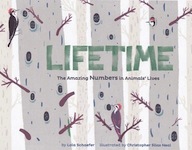
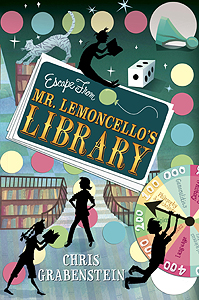
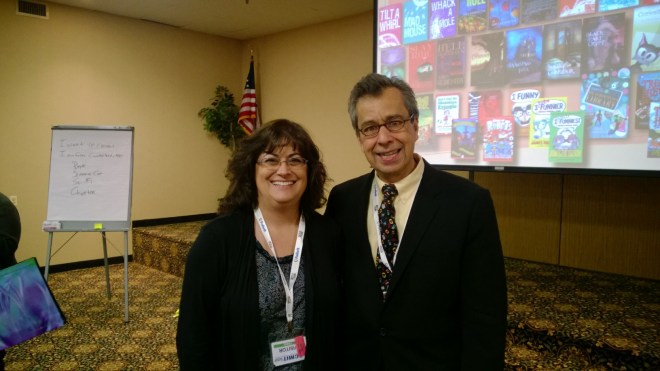
One of the exciting things I was asked by my administration to create was enrichment programs for our 2nd and 4th graders.  This fall I launched “Technology Rocks Information Literacy” to give my students more opportunities to do more in depth research and create projects using technology.  Students were invited based on their MAP-R scores,  and I have twelve 2nd graders and thirty-four 4th graders participating this session.    I meet with the 2nd graders twice a week for 30 minutes, and with each of the 4th grade groups once a week for 30 minutes.  I chose two MASL 2014-2015 Black-Eyed Susan books upon which to base the programs:    Lifetime cover final_0Lifetime by Lola Schaefer andlemoncellos-library-300h Escape from Mr.Lemoncello’s Library by Chris Grabenstein.   I have asked the 2nd graders to research one of the animals in the book Lifetime, and create a Google presentation based on their research to be shared with their classmates and teachers.  After reading the book (and working through all the riddles within it), my 4th graders will be creating book trailers and a scavenger hunt for all the Flower Hill students.  We will be culminating our fall session with a Google Hangout session with the author (whom I was thrilled to meet in person at MASL conference after having emailed back and forth for some time)!Chris Grabenstein   MCPS launched Google Apps for Education this year, and rolled out Chromebooks to the 3rd and 5th graders; my goal is to prepare not only these 2nd and 4th grade students, but all of my students (and staff!), to the Google products and to build their computer navigation skills for the rigors of PARCC online testing.
In October, my PreKindergarten through 2nd grade students participated in Read for the Record (a partnership between Jumpstart and We Give Books), and we made good use of the activity guides for the book Bunny Cakes by Rosemary Wells.

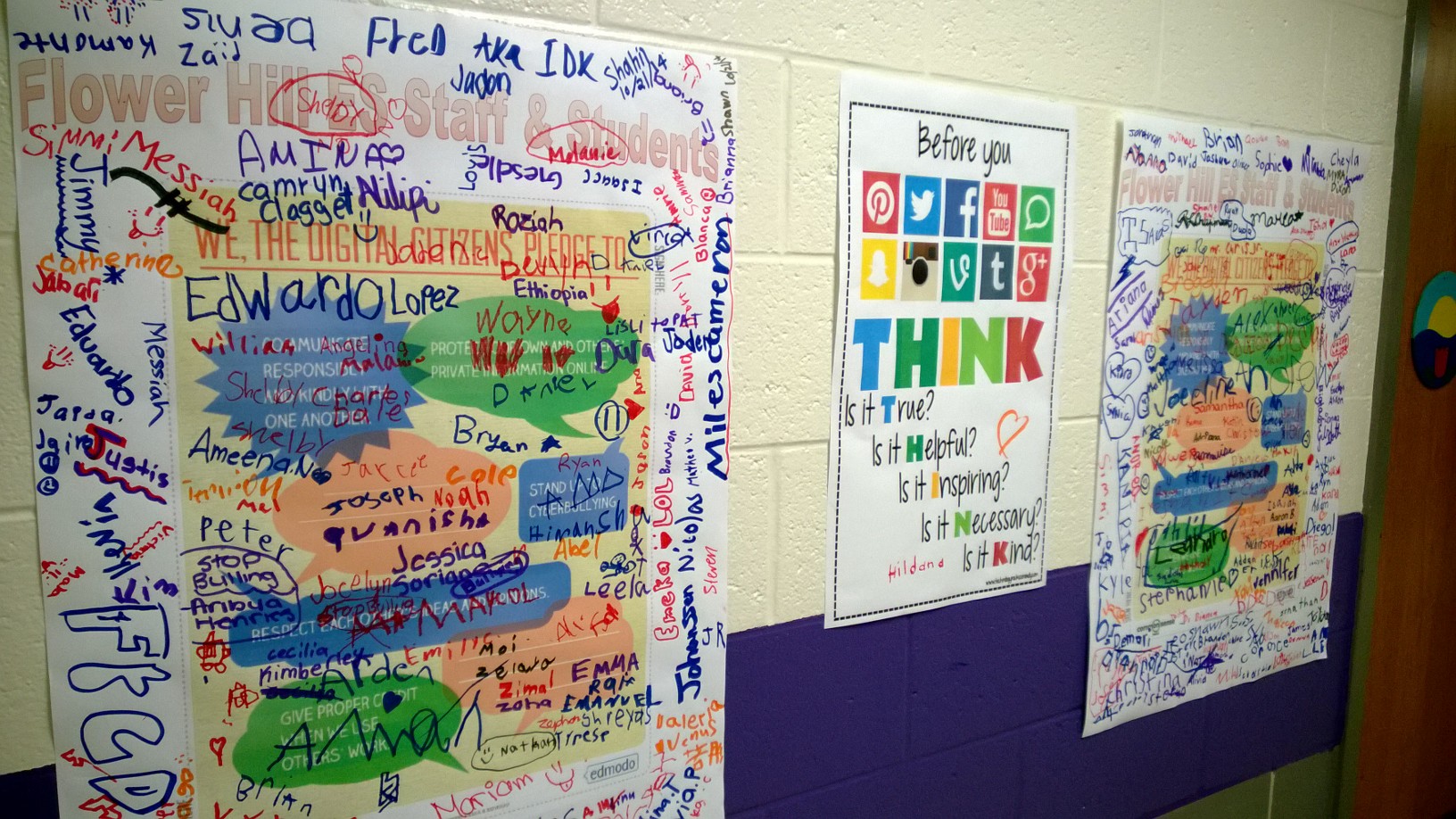
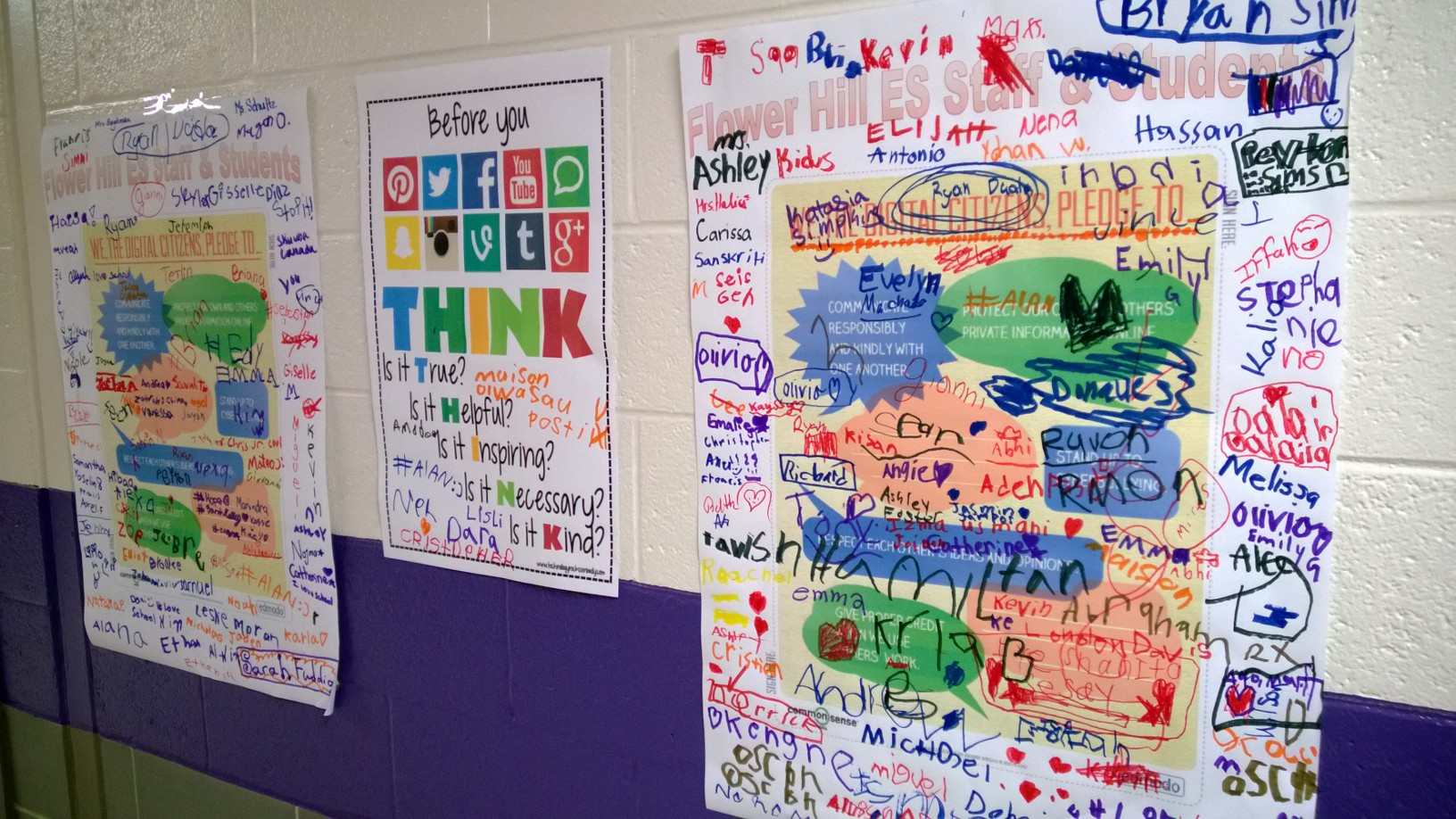
Here at Flower Hill ES we also celebrated Common Sense Media’s Digital Citizenship Week , and continued conversations about staying safe on line.  CSM has created two great videos – one geared towards elementary students “Pause and Think Online” and another (with Flocabulary), for middle and high schoolers “Oversharing:  Think Before You Post”,

I  asked all my students and staff to sign the Digital Citizenship Pledge  and shared with them these THINK bookmarks  created by Technology Rocks seriously blogger Shannon Long.  Digital Citizenship Day Digital Citizenship Day2 It is amazing the engagement when you start talking about being safe online, posting on Facebook, Instagram, etc., and discussing the reasons for minimum ages on social media. Even the youngest of students emphatically shares their personal experiences with online games and social media!

Look for another post soon!  Happy November!